
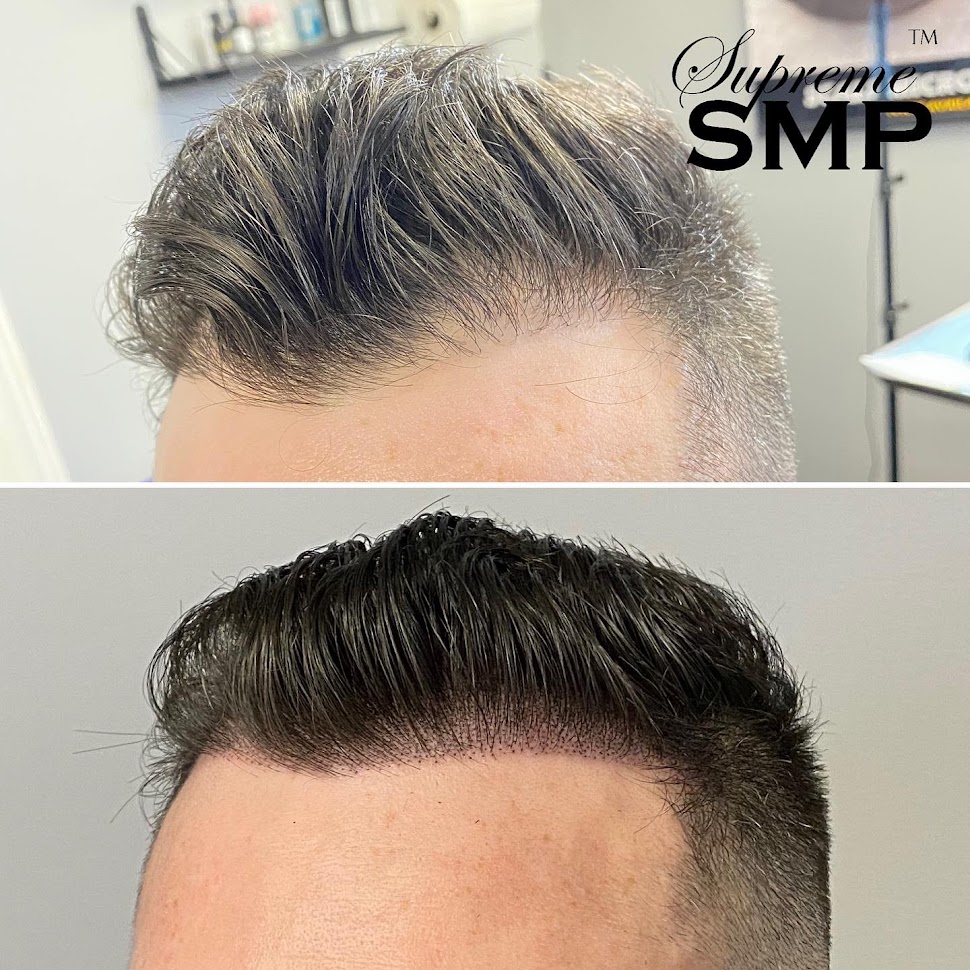

You’ve still got hair, it’s just not doing much covering anymore. The scalp shows through under bright light, in photos, and when the wind picks up, leaving you stuck between shaving it all off and pretending it isn’t happening. This article explains how density-focused SMP fills in thinning patches while keeping the hair you’ve got.
Scalp micropigmentation for thinning hair men isn’t the same treatment as the full shaved-head look most people picture. Density SMP deposits pigment dots between your existing strands rather than across a bald scalp, closing the gap between hair and skin so the area reads as fuller. It’s a different technique with different rules, and getting those rules wrong is where a lot of poor results come from.
How density SMP actually fills in thinning areas
The technique starts with pigment depth. Dots go in at roughly 1.5 to 2 millimetres, sitting at the epidermal-upper dermal boundary. Go shallower and the pigment fades within months. Go deeper and it can spread or blur under the skin, which is where that dreaded blue-grey tinge comes from.
Dot placement is where density work really diverges from a full scalp treatment. On a shaved-head case, dots go in dense and uniform, aiming to replicate a buzzcut. For thinning areas, the approach is scattered and irregular, mimicking how real follicles sit unevenly across the skin. Early sessions might place 40 dots per square centimetre; by the final pass, some areas build to 80 or more, but always working around your existing hair rather than over it.
Needle choice matters too. A fine single-point needle, around 0.2mm, handles hairline edges and fine blending work. A slightly broader triple-point needle covers larger thinning areas like the crown or mid-scalp faster, while still keeping the stippled, irregular texture that reads as natural. The goal at every stage is optical density: making the eye perceive more hair than is actually there, without a single dot looking artificial under close inspection.
Most men need two to four sessions to get there, spaced a few weeks apart so the scalp settles and pigment retention becomes visible before the next pass. A session typically runs one to three hours depending on the area covered. Numbing cream isn’t used as standard here, since it can interfere with how pigment settles in some skin types, though it’s available and applied an hour beforehand if you’d prefer it.
Who this treatment actually suits
Density SMP works best on men with diffuse thinning, meaning the hair is still there but has miniaturised, gone finer, or thinned unevenly, rather than vanished completely. Think early to mid-stage male pattern hair loss, the kind driven by DHT gradually shortening the growth cycle, which affects at least half of men by age 50. If you can still see scalp through the hair but the hair itself hasn’t disappeared, you’re likely a strong candidate.
It also suits men managing scarring from previous procedures, small bald patches from alopecia areata, or areas thinned by scalp scarring, provided there’s enough surrounding hair to blend into. Skin type plays a role too. Very oily skin can accelerate how quickly pigment fades, while drier, more mature skin tends to hold results longer. Active scalp acne, psoriasis flare-ups, eczema, or keloid-prone skin are reasons to hold off until the skin settles.
Where density SMP isn’t the right call: men who’ve lost hair almost entirely in an area, since there’s nothing left to blend with and a fuller-coverage approach works better there. It’s also not a fix for the underlying hair loss. SMP doesn’t stimulate regrowth or affect the follicles that are still miniaturising; it camouflages what’s visible now. Some men pair it with topical treatments to slow further thinning while using SMP to manage the appearance in the meantime.
What healed results look like and how long they last
Healing takes about a month from your final session. The first four days call for no water, no shampoo, no sweating, and no shaving on the treated area. Days five to ten allow gentle washing but no sun exposure. From day ten onward, SPF becomes essential and normal grooming can resume, though swimming pools are best avoided for a full 28 days while pigment settles.
Once healed, expect the dots to soften slightly in tone, which is normal, and the area should read as visibly denser hair rather than a treated scalp. Results from density work typically hold for one to three years before a top-up is worth booking, with sun exposure, skin oiliness, and cellular turnover all speeding up how fast the pigment softens. Regular SPF 30 to 50 on the scalp noticeably extends how long the result stays sharp.
Cost is usually broken down per session rather than as one flat figure, since the number of sessions and area covered both affect the total. Ask any practitioner for a session-by-session breakdown before booking, and factor in that a touch-up down the line is part of the normal lifecycle, not a sign anything went wrong.
Frequently Asked Questions
Does SMP work if I still have most of my hair?
Yes, this is exactly what density SMP is designed for. Pigment dots go between existing strands rather than across a shaved scalp, closing the visual gap between hair and skin so thinning patches look fuller without changing your current hairstyle.
How many sessions does SMP density treatment for men usually take?
Most men complete density SMP over two to four sessions, spaced a few weeks apart. Each session typically runs one to three hours depending on how much of the scalp needs work, with pigment built up gradually across visits rather than all at once.
Will SMP look obvious or fake once it’s healed?
Not if the dot placement is irregular and the pigment shade matches your natural hair colour. Density SMP uses scattered, uneven dot patterns that mimic how real follicles sit, so healed results read as texture and depth rather than a visible pattern.
How do I find someone qualified for SMP near me?
Look for a practitioner with body art licensing, blood-borne pathogens certification, and a portfolio showing healed density work specifically, not just full shaved-head cases. Ask how many density sessions they’ve completed and request to see results at the six-month mark, not just immediately after treatment.
Does scalp micropigmentation stop hair loss from getting worse?
No, SMP doesn’t affect the follicles causing your hair loss or slow further thinning. It camouflages the visible scalp show-through by adding pigment density between strands. Some men combine it with separate treatments aimed at the underlying hair loss for a fuller long-term approach.
Ready to talk it through?
Supreme SMP in Wilmington offers a personal consultation to answer your questions and recommend the right approach for you. Get in touch with Supreme SMP to book your consultation.