
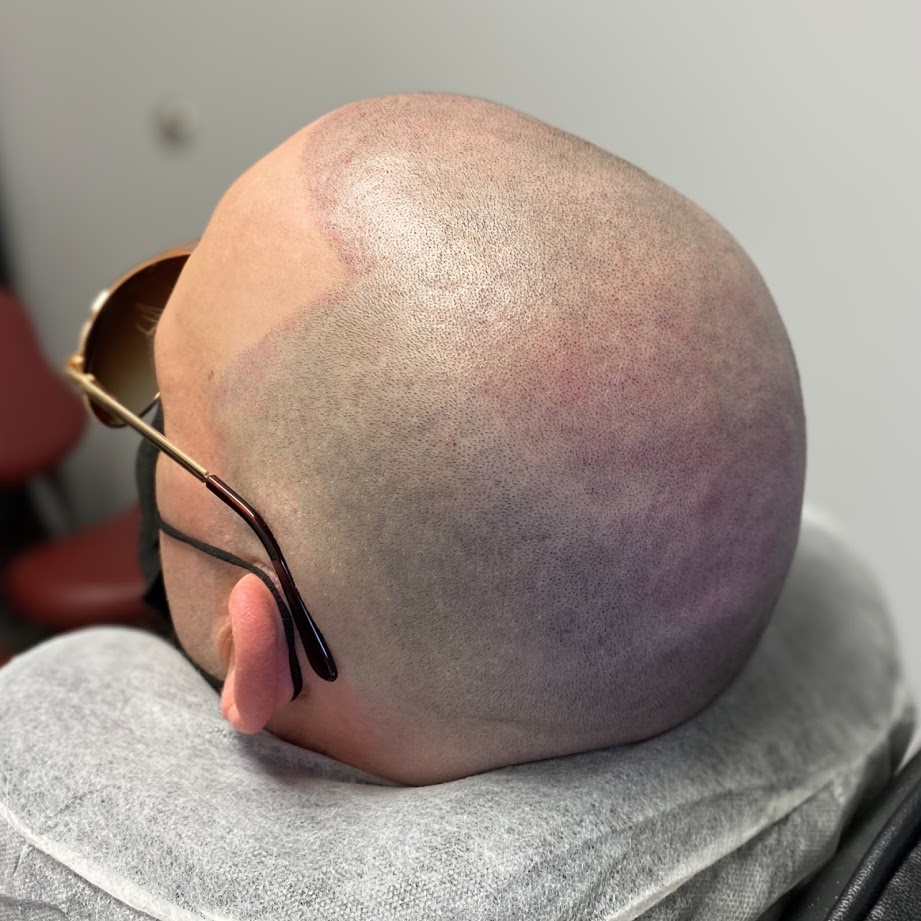

You’ve decided a hair tattoo is the right call, and now you want a straight answer: how many times will you need to sit in the chair before this looks finished? Not a vague range, and not “it depends” without an explanation. This article breaks down the actual session structure, the healing gaps between visits, and what your scalp will look like at each stage.
Most SMP clients need between two and four sessions to reach a finished result, spaced roughly two to three weeks apart. That’s the honest, specific answer. The exact number depends on how much coverage you need, how much natural hair you’re working with, and whether you’re camouflaging a scar or building density across a fully bald scalp. A client with a receding hairline and thinning crown might be done in two sessions. Someone covering a hair transplant scar or working with alopecia totalis usually needs three, sometimes four.
Why one session is never enough
A hair tattoo isn’t a single pass of ink. It’s built in layers, the same way a tattoo artist builds shading and depth over multiple sittings rather than trying to nail everything in one go. In session one, the practitioner lays down a foundation pattern at around 40 dots per square centimetre, using a single-point needle at the hairline and a triple-point needle for the crown and mid-scalp. That first pass is deliberately conservative. It establishes the shape, the hairline position, and the direction the pattern will follow.
The scalp needs time to heal and settle before anyone can judge how the pigment has taken. Pigment sits at a depth of roughly 1.5 to 2 millimetres, right at the boundary between the epidermis and upper dermis, and the skin’s healing response affects how it looks once it’s fully settled. Some pigment always softens slightly as the skin turns over in the days after treatment, so session one always looks a little heavier and more solid immediately afterwards than it will two weeks later.
Session two is where density gets built up, typically to 60 to 80 dots per square centimetre, filling in gaps and adding the depth that makes the pattern look like real hair follicles rather than a flat block of colour. By session three, if needed, the focus shifts to refinement: tightening the hairline, correcting any patchy areas, and pushing density up towards 80 to 100 dots per square centimetre in zones that need it. Each session builds on what healed from the last, which is exactly why this can’t be compressed into one long appointment.
What the standard scalp micropigmentation session structure looks like
Here’s the typical run of appointments. Session one runs three to five hours, depending on how much scalp is being covered, and focuses on the hairline shape and the base pattern. You’ll leave with visible pigment that looks slightly darker and more uniform than the final result, because the skin hasn’t finished healing.
Session two happens two to three weeks later, once the scalp has fully recovered from the first pass. This appointment is usually shorter, two to four hours, and it’s where the real transformation happens: density increases, tone gets evened out, and any thin patches from session one get corrected. Most men and women say this is the session where the hair tattoo starts looking convincing at normal viewing distance.
If a third session is needed, it’s scheduled another two to three weeks after session two. This one is about precision rather than volume, tightening irregular hairline edges, softening any harsh lines, and blending pigment tone across the whole treated area so there’s no visible difference between older and newer work. A fourth session is rare and usually reserved for large-coverage cases or significant scarring, where the skin takes pigment less predictably.
Numbing cream isn’t routinely used for these sessions, since it can affect how well pigment settles depending on your skin type and reaction. If you’re anxious about discomfort, it is available and applied about an hour before treatment begins.
What healing between sessions actually looks like
Hair replication healing between sessions follows a fairly predictable pattern, and knowing what to expect stops people panicking over normal healing behaviour. On days one to four, you keep the scalp completely dry: no water, no shampoo, no sweating, no shaving. The area will look slightly red and the pigment will appear darker and more saturated than it will end up being.
From day five to day ten, you can start gentle washing, but sun exposure is still off-limits. This is when the top layer of pigment, sitting in the epidermis, begins clearing through natural skin turnover, which is why the pattern softens slightly and starts looking more natural rather than freshly inked. From day ten onwards, you can apply SPF to the scalp and get back to normal grooming, though swimming pools stay off the list for a full 28 days after each session.
Full healing takes about a month per session. That’s not downtime where you’re hiding indoors; it’s simply the window needed for the dermal pigment to settle and for any redness or texture change to fully resolve. This is exactly why sessions are spaced two to three weeks apart rather than back to back: going in too soon means working on skin that hasn’t finished revealing what the last session actually achieved.
When to judge the final result
Don’t assess the outcome straight after your last session. Judge it 30 days later, once healing is complete and the pigment has settled into its true, final tone and density. Immediately post-treatment, density can look excellent, but the honest picture only emerges once the skin has fully recovered.
Once healed, a properly done hair tattoo typically holds its density and colour well for one to three years before a top-up is worth considering. Skin type, sun exposure, and how oily or dry your scalp is all affect how long it stays crisp. Regular SPF on the scalp is the single most useful habit for stretching that timeline out.
Frequently Asked Questions
How many SMP sessions does it take to finish a hair tattoo?
Most clients complete their hair tattoo in two to four sessions, spaced two to three weeks apart. Two sessions often suffice for straightforward hairline or crown work, while three to four sessions are typical for full-scalp coverage, scarring, or advanced hair loss requiring more density built up gradually.
How long do you wait between SMP sessions?
You typically wait two to three weeks between sessions. This gives the scalp time to fully heal from the previous pass so the practitioner can accurately judge pigment retention and density before adding more, rather than working over skin that hasn’t settled yet.
What does the scalp look like right after the first SMP session?
Immediately after the first session, the pigment looks darker and more solid than the final result. Some redness is normal for two to three days. The pattern softens over the following weeks as the epidermis turns over and the true healed tone emerges.
Is numbing cream used during SMP sessions?
Numbing cream isn’t routinely used because it can affect how pigment settles depending on skin type and reaction. It’s available on request and applied around an hour before the session for clients who are concerned about discomfort during treatment.
How long does a finished hair tattoo last before needing a touch-up?
A completed hair tattoo typically holds its density and colour well for one to three years before a top-up is recommended. Sun exposure, skin type, and oiliness affect fading speed, so regular SPF on the scalp helps extend the result between touch-ups.
Ready to talk it through?
Supreme SMP in Wilmington offers a personal consultation to answer your questions and recommend the right approach for you. Get in touch with Supreme SMP to book your consultation.